
The digital marketing industry never stands idle; across the web, innovations and updates frequently occur, impacting campaign strategies and initiatives. One of the latest developments is the rise of zero click searches which are changing how Active Web Group’s Pay-Per-Click professionals are approaching our PPC strategy.
Zero-click searches are long-tail search terms users input to find answers directly on the search engine results page (SERP) without needing to click through to a website. These are driven by new browser features like AI Overviews, featured snippets, knowledge panels, or maps that provide immediate information. This trend means users receive quick answers (e.g., “what’s the time in Fairbanks, Alaska,” “how many calories in an orange”) without visiting other sites, thereby potentially reducing organic site traffic but increasing brand visibility if the search engine sources data from your site.
How Zero Click Searches Work
- Instant Answers: Search engines aim to satisfy queries with on-page content, like displaying a recipe, definition, or local business hours directly.
- SERP Features: These include AI Overviews (AIOs), Featured Snippets, People Also Ask (PAA) boxes, Knowledge Panels, and Map Packs
- Examples: Searching “what time is it in Sydney AU” or “how many inches in a meter” often yields immediate results.
Zero Click Searches’ Impacts on SEO and Digital Marketing
- Decreased Traffic: Businesses may see fewer clicks to their site for informational queries, as the user’s need is met on the SERP.
- Increased Visibility: Appearing in these features boosts brand authority and awareness, even without a click.
- New Optimization Goals: Marketers focus on creating content that can be pulled into AI Overviews, using schema markup, and answering questions directly to be cited as a source.
Zero-click searches and Google zero-click searches in particular, are increasing because search engines are evolving from mere “directories” into “answer engines”. This trend, accelerated by AI and changing user behavior, means that roughly 60% of Google searches now end without a click. At the onset of this trend, AWG’s PPC team took notice and have adapted our client campaigns to benefit from these changes and to prevent negative campaign impacts.
Here is a detailed breakdown of why zero-click searches are increasing:
- Rise of AI-Generated Answers: The introduction of AI Overviews (formerly SGE) in Google, as well as AI-powered platforms like ChatGPT and Perplexity, allows users to receive comprehensive, synthesized answers directly at the top of the search page.
- Expansion of SERP Features: Google zero click searches continue to expand “rich results” designed to satisfy intent immediately. These include Featured Snippets, Knowledge Panels, “People Also Ask” boxes, and local map packs.
- Demand for Instant Gratification: Users increasingly prefer to get quick, concise answers to straightforward questions (e.g., weather, time, simple calculations) without navigating to a website, saving time and reducing friction.
- Mobile-First Behavior: On mobile devices, where screen space is limited, immediate answers are more convenient than scrolling through traditional “blue links,” with mobile searches seeing a higher incidence of zero-click results.
- Search Engine Monetization Strategy: Search engines like Google benefit from keeping users on their platforms longer, which allows for higher ad impressions, increased engagement with their own products (e.g., Maps, Shopping), and more data collection.
- Shift in Voice Search: With the growth of virtual assistants (Siri, Alexa), searches are becoming more conversational and intent-driven, leading to a single, direct answer rather than a list of options.
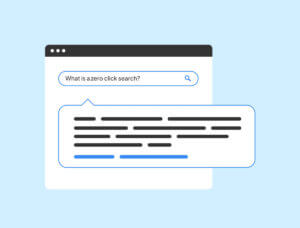
What is the Impact of Zero Click Searches on the Digital Landscape?
As of 2025, around 80% of consumers rely on zero-click results for at least 40% of their searches, contributing to a 15-25% drop in organic traffic for many websites. While this reduces clicks, it provides an opportunity for PPC experts to position client brands to gain visibility and authority by having their content featured in AI summaries.
1. Shift PPC Strategy Success Metrics From Clicks to Commercial Intent
It is important for stakeholders to realize that zero-click doesn’t eliminate intent—it just filters out low-value clicks.
PPC Marketers’ Actionable moves
- Re-optimize campaigns around bottom-funnel actions, not CTR:
- Qualified form fills
- Phone calls (with duration thresholds)
- Appointment bookings
- Store visits / conversions
- Use offline conversion tracking and CRM integrations to tie ad spend to real revenue.
Result
- Fewer wasted clicks
- Clear ROI attribution even when SERPs absorb early-stage queries
2. Dominate High-Intent SERP Real Estate (Even Without the Click)
If users don’t click, your brand must still own the decision moment.
PPC Strategy’s Actionable Moves
- Aggressively deploy:
- Call-only & call-extension campaigns
- Location extensions + local service ads
- Structured snippets & price extensions
- Ensure ad copy answers:
- Pricing qualifiers
- Service scope
- Geographic coverage
- Trust signals (years in business, certifications)
Result
- Users convert directly from the SERP
- Competitors lose share even without a landing-page visit
3. Replace Informational PPC With Demand Capture + Demand Creation
Zero-click affects research queries, not buying decisions.
PPC Strategy’s Actionable Moves
- Reduce spend on:
- “What is…”
- “How does…”
- Reallocate budget toward:
- Branded protection campaigns
- Competitor conquesting
- In-market and custom intent audiences
- Layer YouTube, Display, and Discovery ads to create recall before the search happens.
Result
- Searches shift from generic to branded
- Higher conversion rates at lower CPCs
4. Engineer Landing Pages for Conversion Speed, Not Education
If the SERP already educated the user, the page must close, not teach.
PPC Strategy’s Actionable Moves
- Design zero-friction landing pages:
- Single-action layouts
- Above-the-fold value + CTA
- Dynamic content tied to keyword intent
- Use A/B testing on:
- Headlines that mirror SERP language
- Trust badges and proof points
- Short vs. long forms based on intent level
Result
- Higher conversion rates from fewer clicks
- Stronger ROI despite reduced traffic volume
5. Exploit First-Party Data & Remarketing Loops
Zero-click searches make re-engagement more valuable than acquisition volume.
PPC Strategy’s Actionable Moves
- Build remarketing audiences from:
- Site visitors
- Video viewers
- CRM and email lists
- Deploy sequential messaging:
- Awareness → proof → offer
- Use RLSA (remarketing lists for search ads) to bid more aggressively on high-value users.
Result
- Lower CPA
- Predictable performance even as search behavior changes
6. Continuous SERP Monitoring & Intent Mapping
Zero-click is not static—SERPs change monthly.
PPC Strategy’s Actionable Moves
- Track:
- Featured snippets
- Local pack shifts
- AI-generated answers
- Adjust keyword targeting and ad copy before CPC inflation hits.
- Pause keywords where Google zero click searches have effectively removed commercial opportunity.
Result
- Proactive optimization instead of reactive budget loss
Final Score: Clients see stability while competitors scramble
Bottom Line for PPC Clients
Don’t fight zero-click searches—re-engineer clients’ PPC campaigns around it, incorporating the most effective aspects so you achieve greater ROI.
With intervention/campaign adaptation, fewer clicks now leads to: Higher intent/ Better conversion economics/Measurable revenue impact.

Prepare Your PPC Strategy for 2026—Before the Market Forces It
Zero-click search, AI-driven SERPs, and rising CPCs are not future risks—they are active forces reshaping paid media performance right now. Active Web Group helps brands move beyond outdated click-based models and into revenue-focused PPC strategies built for 2026 and beyond. By realigning budgets around intent, conversion velocity, and first-party data, we protect ROI while positioning our clients ahead of competitors still chasing disappearing traffic. Now is the time to audit, re-architect, and future-proof your PPC initiatives. Connect with Active Web Group to develop a 2026-ready paid search strategy that converts attention into measurable growth. Call today!
